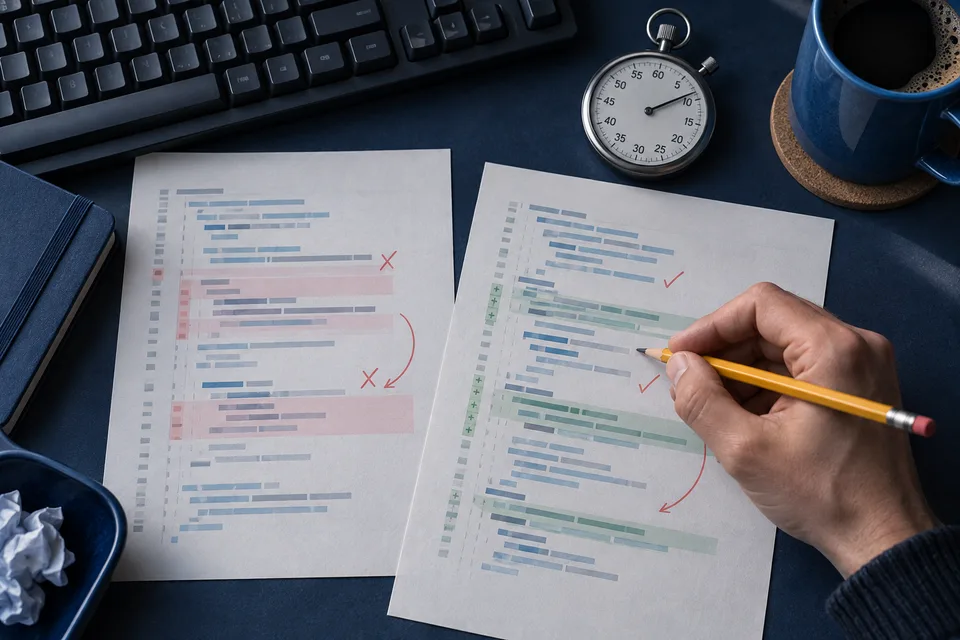
Compare three uses for a missing word: a joke in an entertainment clip, a technical term in a lesson and the date in a library’s event video. The same recognition error can leave a viewer puzzled, teach the wrong idea or send someone to the wrong place. These are hypothetical examples of a common editorial job. Automatic captions supply a draft; the person publishing the video still has to decide whether the information survives on screen.
A user who cannot hear the soundtrack should not have to infer which parts of the text are trustworthy. Yet a high overall transcription score can coexist with an incorrect name, time, negation or speaker assignment. The accessibility question is whether the captions communicate the information needed to understand and use the content, including information that is not spoken as words.
Automatic speech recognition can be a valuable part of producing that result. It can also be mistaken for the finished result. The distinction becomes clearer when the three screens are examined in turn, with attention to what the viewer is trying to do rather than only how many tokens a model transcribes correctly.
Screen one: the clip that has a soundtrack
The entertainment clip contains a joke followed by laughter from someone outside the frame. A transcript of spoken words might preserve the joke while leaving the source of the laughter ambiguous. If the identity or timing of that sound matters to the scene, the words alone do not reproduce the experience the soundtrack supplies.
The W3C Web Accessibility Initiative’s captions guidance describes captions as synchronized text conveying speech and non-speech audio information needed to understand the content. It also explains that automatic output generally needs checking and editing. Captions therefore involve selection, timing and presentation as well as recognizing a sequence of words.
Style can interfere with that function. Large animated text may be attractive in a social clip but cover an important expression or disappear before a reader can finish it. A word-by-word effect can emphasize the speaker’s rhythm while making a sentence harder to scan. The right assessment considers the viewing experience, rather than equating conspicuous text with successful access.
The clip might also contain multiple speakers with similar voices. A recognition system can transcribe the words accurately while leaving the viewer unsure who said them. Speaker identification needs enough context to make the exchange intelligible, particularly when the image does not show the person speaking. The editor should avoid inventing an identity when the source itself does not establish one.
Even in entertainment, wrong words can alter meaning rather than merely create an amusing typo. A sarcastic line and an earnest one may rely on audio context. Captions cannot encode every nuance, but the production process can identify important cues instead of treating all missing sound as irrelevant because it does not fit a speech transcript.
This is also where the economics of automatic drafts can be helpful. A usable first pass may leave an editor more time to check timing, names and necessary sound descriptions. That benefit should be evaluated in the actual workflow. If a polished automatic draft encourages the publisher to skip review entirely, the tool has changed the process in a different way.
Screen two: the lesson that introduces unfamiliar words
In the recorded lesson, the speaker uses a new technical term and then explains it. A recognizer may replace the unfamiliar term with a common phrase that sounds similar. The rest of the sentence can remain grammatical, making the error difficult to notice from text alone. A learner may then write down a plausible but incorrect term and struggle to find the relevant material later.
A lesson can contain information distributed between speech and visuals. The lecturer might say this expression while pointing to an equation, or refer to a diagram by a short label. Captions preserve the audio channel but do not automatically describe the visual one. Planning access requires recognizing those separate needs rather than assuming one text track can silently replace every part of the presentation.
Timing matters because the learner is combining channels. A caption that appears after the relevant slide has changed can make an otherwise accurate transcript difficult to follow. A caption that remains while another speaker begins can create a false association. The relevant test is the synchronized lesson, not only a downloaded text file read on its own.
Vocabulary preparation can help a production team inspect the places where errors are most consequential. Names, abbreviations and specialized terms deserve attention, with the authoritative spelling drawn from the actual lesson materials or speaker. A guessed correction can be as misleading as the original automatic error. Review needs a route back to the content, not just a spellchecker.
Performance also varies across speech conditions and speakers. The 2020 PNAS study Racial disparities in automated speech recognition tested five commercial systems using interviews with 73 Black and 42 white speakers. It reported average word error rates of 0.35 and 0.19 respectively in the matched audio. Those are findings from that study, not current performance figures for those providers. They show why one aggregate can hide a substantial difference between groups.
There is also a measurement problem inside that comparison. A 2024 reexamination using Whisper and the CORAAL dataset found worse performance on African American English while identifying an additional influence: recording practices varied by study location along with language use. The authors called this confounding by provenance. Their result does not make the accessibility disparity disappear; it complicates attribution of its causes.
For a publisher, both findings point toward a more informative trial. Preserve speaker coverage, but record microphones, room noise and recording methods too. If one group was captured on a poor remote connection and another in a studio, the service still needs to serve both; the diagnosis and remedy should distinguish an acoustic setup problem from the recognizer’s language coverage.
A small internal sample can miss that problem if it contains only the clearest recordings or the staff most familiar with the system. Testing should reflect relevant accents, languages, speaking patterns and recording conditions, within a proportionate and appropriately authorized process. The goal is not to ask speakers to erase their characteristics so that a metric improves; it is to understand whether the captioning arrangement serves its audience.
The final teaching record may include both captions and a transcript. They can support different uses, such as following the recording and searching its content. Corrections should reach the versions students actually use. A corrected video track alongside an obsolete downloadable transcript leaves the same mistake available through another route.
Screen three: the event someone needs to attend
The fictional library video says that an event starts at nine in the morning and requires visitors to use a particular entrance. Here a caption error can affect a concrete decision about where to go or when to arrive. An otherwise excellent transcription is not enough if it changes those details.
Word error rate counts substitutions, deletions and insertions, divided by the number of reference words. In a hypothetical hundred-word transcript, one deleted word and no other errors produces 1% WER. That calculation is identical whether the missing word is an ordinary article or the not in an instruction not to use an entrance.
WER remains useful for comparing transcription under stated scoring conditions. It does not weight that negation according to the visitor’s consequences, measure whether the caption appeared at the right moment or check whether an off-screen speaker was identified. Those are additional checks on different properties, not reasons to discard the metric.
Careless Whisper, first submitted in 2024, found invented phrases in 1.4% of the transcriptions in its dataset, using experiments from April and May 2023. The audio came from AphasiaBank and included speakers with aphasia and controls. Longer non-vocal periods were associated with hallucination in the authors’ analysis. That sample and timing matter: 1.4% is not a current error rate for every caption product, nor a prediction for the library’s recording.
It identifies a different review question. Alongside checking whether spoken information was missed, listen where a confident sentence appears during a pause. A recognizer can add material that the publisher cannot repair by checking spelling alone.
For a public information video, the review should compare important details with the actual source. It should not quietly rewrite the speaker into what the editor thinks the organization meant. If the video itself states an incorrect event time, accurate transcription alone preserves the error. The organization needs a correction to the underlying information and a clear way to keep the related materials aligned.
This makes ownership important. A video producer may understand timing and file formats, while the event organizer knows which entrance or schedule is correct. A reliable workflow connects those responsibilities. Leaving both to assume that the other has checked the details can produce an attractive, technically valid caption file that still misinforms the visitor.
Access should not depend on the viewer identifying the fault first. A reporting route is valuable for mistakes that escape review, but it is an additional repair mechanism rather than the entire quality process. Someone using captions should not need to hear the original audio in order to prove that a caption is wrong.
What all three screens need before publication
The production process should distinguish an automatic draft, a reviewed text and a checked viewing experience. These stages can be supported by tools and competent people in different arrangements. The meaningful question is what each stage has established, including whether the delivered file matches the reviewed one. A status called complete is unhelpful if nobody knows which checks it includes.
Review at the level of the actual task. Speech accuracy matters, but so do synchronization, relevant sounds, speaker changes and obstruction of important visuals. A text-only review may catch spelling while missing timing. Watching only a silent extract may reveal layout while making it difficult to verify the spoken words. Different observations contribute different evidence.
The player is part of the result. Users need an understandable way to enable captions where they are optional, readable presentation and behavior that works on the intended devices. A good caption file attached to a player that never exposes it does not deliver access. Check the published version through the route an audience member will actually take.
Live media adds a different constraint: a correction may arrive after the audience has already relied on the initial text. The service should define an appropriate live-captioning arrangement for its context and review the recording before later publication. A useful live approximation and an edited permanent record are distinct offers. Calling the recording finished merely because captions were present during the event skips that distinction.
Translation introduces another stage again. A translated subtitle can faithfully translate an incorrect transcript. Correcting the source track may not automatically update the translated versions, and a technically accurate translation can still mishandle a name or specialized expression. Keep the dependencies visible so that a repair reaches the relevant audience instead of stopping at the first language.
The same applies to clips cut from a longer recording. Caption timing and speaker context can change at the edit boundary. A track that worked in the full program may start too late or include context no longer visible in the excerpt. The derivative needs its own viewing check, rather than inheriting a completion label from the original file.
The useful quality claim
A publisher can make a more informative claim than the model is accurate. It can identify the production arrangement, the checks completed and a usable correction route, while keeping any remaining limitations specific. The relevant legal or contractual requirements depend on the service and jurisdiction; a technology score alone does not determine whether they have been met.
For an audience member, the question is more immediate. Can they understand who spoke, what mattered and how the text relates to the screen? Can they obtain the event time or follow the unfamiliar concept without reconstructing missing audio? These are outcomes a production team can examine with the intended users, rather than infer solely from a recognition leaderboard.
The three screens need different editorial attention, but none benefits from confusing an automatic transcript with an accessible experience. Better recognition can reduce part of the work. The remaining work is not an embarrassing imperfection to hide; it is the process that turns recognized words into information people can depend on.
Sources & context
This article draws on the sources linked in the text. Analysis and illustrative scenarios are identified separately from reported findings.
- W3C Web Accessibility Initiative's captions guidance
- Racial disparities in automated speech recognition
- 2024 reexamination using Whisper and the CORAAL dataset
- Word error rate
- Careless Whisper